People With Down Syndrome Are Listening
I have been trying to find the words to respond to the post made by YouTuber Jesse Ridgway.
Not just as a mother of a child with Down syndrome, but as the founder of an organization that walks alongside families receiving this diagnosis every day.
And here is where I keep landing:
This is not okay.
A child’s life ended because of a diagnosis. And then that decision was publicly explained, justified, and defended through inaccurate information, assumptions, stereotypes, and fear about people with Down syndrome.
That should grieve all of us.
This is not simply about one social media post. This is about the public narrative around Down syndrome. A narrative that has real consequences. A narrative that tells families their child’s life will be defined by suffering. A narrative that presents disability as tragedy. A narrative that reduces people with Down syndrome to a list of possible complications, limitations, burdens, and worst-case scenarios.
That narrative is not harmless.
That narrative is part of what is eliminating Down syndrome.
Not because people with Down syndrome are not worthy of life.
But because the world keeps telling families they should be afraid of that life.
The most painful part is watching someone with a large platform speak as if they are an expert on Down syndrome while sharing inaccurate statistics and assumptions as though they are facts.
That matters.
Because families are listening.
Medical providers are listening.
The public is listening.
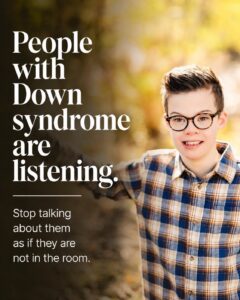
And people with Down syndrome are listening.
What if Jack read those words?
What if Kirsta read those words?
What if the very people being described as burdens, risks, outcomes, and “choices” are in the room?
Because they are.

We often talk about people with Down syndrome as if they cannot understand what is being said about them. As if their dignity is somehow dependent on their ability to defend it. As if it is acceptable to publicly discuss whether lives like theirs are worth living because they have a diagnosis.
It is not.
We would not tolerate this kind of language about other groups of people. We would not accept a public explanation that reduced an entire population to medical needs, dependence, cost, challenge, and hardship — and then called avoiding that life a better outcome.
So why is it acceptable when the people being described have Down syndrome?
A baby with Down syndrome is not bad news.
A baby with Down syndrome is not a tragedy.
A baby with Down syndrome is not an objective burden.
A baby with Down syndrome is a baby.
And a diagnosis is not the full story of a person’s life.
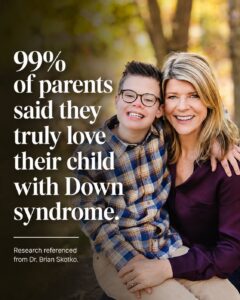
If we are going to talk about statistics, then let’s talk about the statistic that is almost never shared when a diagnosis is given: the overwhelming majority of people living with Down syndrome report loving their lives.
I know a lot of people without Down syndrome who cannot say the same.
And that is where the bias becomes so obvious.

We live in a world full of pain, violence, loneliness, anxiety, addiction, greed, brokenness, and crisis. I do not turn on the news and think, “People with Down syndrome are the ones causing harm in the world.”
And yet somehow, we have convinced ourselves that babies with Down syndrome are the lives to be feared. The lives to be avoided. The lives to be prevented.
Why?
Because their development may look different?
Because they may need support?
Because they may have medical needs?
Because they may not fit the world’s definition of success, independence, productivity, or “normal”?
What the world calls normal looks pretty broken to me.
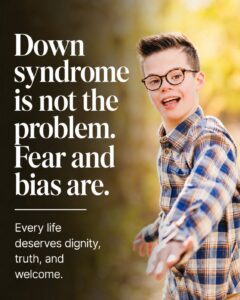
Maybe the problem is not Down syndrome.
Maybe the problem is a world that has decided some lives are more acceptable than others.
Yes, people with Down syndrome may have medical needs. Yes, there can be challenges. Yes, there are unknowns.
But that is true of every life.
None of those things erase a person’s dignity, worth, purpose, joy, relationships, or right to be welcomed.
My son is not a list of possible complications.
He is Jack.
He is a son, brother, friend, student, teammate, performer, encourager, and beloved member of our family and community.
His life has not made our lives less.
His life has made us better.
And I know Jack. I know his heart. I know he would be the first to forgive. But forgiveness does not mean silence. Forgiveness does not mean we pretend this is okay. Forgiveness does not mean we allow the world to keep speaking about people with Down syndrome in ways that are dehumanizing and untrue.
For decades, families have received a diagnosis of Down syndrome through fear instead of truth.
“I have bad news.”
“Your baby has Down syndrome.”
“Do you want to keep her?”
“Your life will be filled with pain and suffering.”
These are not just words. These are messages that shape a parent’s first understanding of their child. These are messages that influence fear, grief, decisions, and outcomes. These are messages that tell families what the world thinks of their baby before they ever get a chance to know who their baby is.
And then we call it “choice” without acknowledging the bias, fear, and misinformation that shaped it.
This is why Jack’s Basket exists.
Because too many parents are told what their child may never do before anyone celebrates who their child already is.
Too many families are handed statistics without stories, risks without relationships, and information without hope.
Too many babies are introduced through a diagnosis instead of a congratulations.
And too many people with Down syndrome are spoken about as if they are not here.
But they are here.
They are listening.
They are worthy.
They are living full, meaningful, beautiful lives.
They are teaching us about love, joy, perseverance, forgiveness, community, and what it means to belong.
People with Down syndrome are not statistics to manipulate.
They are not burdens to justify.
They are not diagnoses to eliminate.
They are human beings.
And before anyone publicly speaks about their lives as if they are experts, they should start by listening to the people actually living those lives — and to the families who know the truth beyond the fear.
This is not okay.
And we will keep doing the work until the narrative changes.
I miss running…
So it’s been at least four months since my last entry and my life has changed dramaticallyR
18 months…Stay tuned to WCCO TV!
Wow, what a month it has been! Where do I even begin to update you on the amazing month we have
Let’s do this better. Speaking at the hospital.
September 8th. I’ve had this date starred on the calendar for over six months. *Speaking at