Someone Always Has a Story
As we head back to school, I’ve been thinking a lot about what our children are learning before they ever open a textbook.
They are learning how to respond to people.
They are watching who we avoid, who we welcome, who we talk about, who we talk to, who we make room for, and who we quietly teach them to keep at a distance.
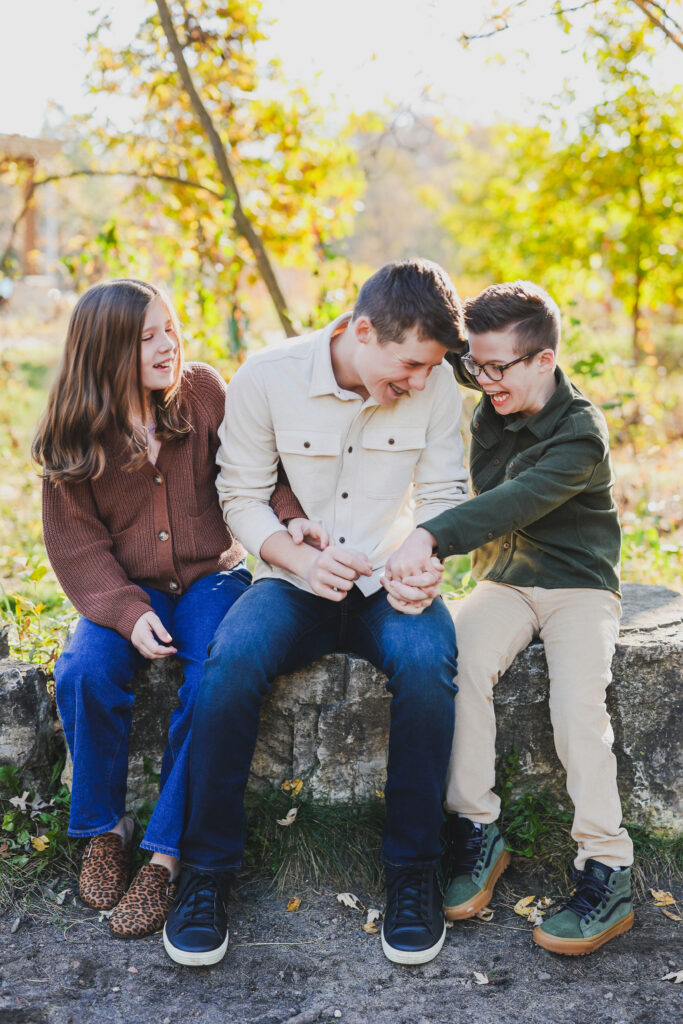
Years ago, I wrote a blog post titled, “How will you respond to your child when he asks about my child?” It came from a tender conversation with my oldest son, Luke, after he noticed kids staring at Jack. His little shoulders were shrugged. His head was down. His mama’s heart was hurting for his brother.
He had seen the way people looked at Jack, and he felt it.
I remember trying to explain to him that sometimes people stare because they do not know. Sometimes they are curious. Sometimes they have never met someone with Down syndrome before. And sometimes, the way we respond in those moments matters more than we realize.
Because when we shush our kids, pull them away, act embarrassed, or avoid the conversation altogether, we may think we are preventing an awkward moment.
But what message are we really sending?
Are we teaching our children that difference is something to fear?
That a disability is something to whisper about?
That questions are bad?
That people who look, communicate, move, or learn differently are somehow wrong?
Imagine how that feels when you are the person being whispered about.
Imagine how that feels when every time you walk into a room, people respond as if something is wrong.
That is what I want us to think about as our children walk back into classrooms, lunchrooms, playgrounds, locker-lined hallways, and neighborhoods this year.
What if instead of fearing the awkward question, we taught our kids to ask better ones?
What is your name?
Do you want to play?
What do you like?
Can I sit by you?
Do you need help?
Those questions can open a door.
And sometimes that door becomes a friendship.
I think about this often because my dad used to tell me to make a friend everywhere I go. Someone always has a story. And the older I get, the more I realize how much wisdom is in that.
On a run with my friend Katie, we used to see an older man along our route. He had to be in his 80s or 90s. Sometimes he was walking across the boardwalk. Sometimes he was sitting on a bench, taking in the morning.
Every time we saw him, we would ask, “How are you?”
And every time, without hesitation, he would respond the same way.
“Phenomenal.”
Not fine.
Not okay.
Not hanging in there.
Phenomenal.
Later, we came to learn his name.
Jack.
Of course it was.
I never knew his whole story, but I wanted to.
I wanted to know what he had lived through. What unexpected turns life had brought him. What losses, joys, disappointments, and celebrations had shaped him. What kept him hopeful. What made a man in his 80s or 90s answer “phenomenal” on an ordinary morning walk.
And I wonder why we have stopped being curious like that.
Why have we stopped taking the time to know someone?
Not a category of people.
Not “a kid with Down syndrome.”
Not “someone with autism.”
Not “a person in special education.”
Not “I knew someone once who had…”
No.
A person.
With a name.
A family.
A story.
A personality.
A purpose.
A child who is someone’s whole world.
What happened to taking the time to know someone?
I wonder how much of the division in our world, our neighborhoods, our schools, and our classrooms comes from the fact that we stopped being curious about each other. We made assumptions instead. We let discomfort lead. We let fear keep us quiet. We looked down at our phones because it was easier than looking someone in the eye.
And maybe this is where the back-to-school invitation begins.
Who do you need to ask a question to this year?
Who might your child need encouragement to get to know?
What is holding you back from interacting with someone who seems different from you?
Is it a diagnosis?
The unknown?
The fear of saying the wrong thing?
The assumptions you have already made?
The effort it takes?
The uncomfortable vulnerability of putting yourself out there?
Or is it simply easier to stay with what is familiar?
Parents, our children are watching.
They are watching how we respond when they ask a question about someone who is different. They are watching whether we panic, shush, redirect, or teach. They are watching whether we model kindness, curiosity, and respect.
And I want to gently remind us that we do not need to have perfect words.
We just need to be willing to see people.
We can say, “That is a great question. Everyone is different, and differences are not bad. Let’s learn their name.”
We can say, “He may communicate differently, and I believe he still has a lot to say.”
We can say, “She may need extra support, and she belongs here too.”
We can say, “Let’s go say hi.”
Because our children do not just need to know how to read, write, solve equations, and pass tests.
They need to know how to love their neighbor.
They need to know that every person matters.
They need to know that behind every diagnosis, disability, behavior, difference, or label is a person with a story worth knowing.
So as we head back to school, maybe the invitation is simple.
Look up.
Ask a question.
Learn a name.
Make a friend.
Teach your child that curiosity does not have to become judgment. It can become connection.
And maybe the next time they see someone who looks different, talks differently, learns differently, or moves through the world differently, they will not turn away.
Maybe they will remember that someone always has a story.
And maybe, if they take the time to ask, they might just meet someone phenomenal.
I miss running…
So it’s been at least four months since my last entry and my life has changed dramaticallyR
18 months…Stay tuned to WCCO TV!
Wow, what a month it has been! Where do I even begin to update you on the amazing month we have
Let’s do this better. Speaking at the hospital.
September 8th. I’ve had this date starred on the calendar for over six months. *Speaking at
Leave a Reply